
What to Ask on Every Plumbing Call Before You Roll the Truck
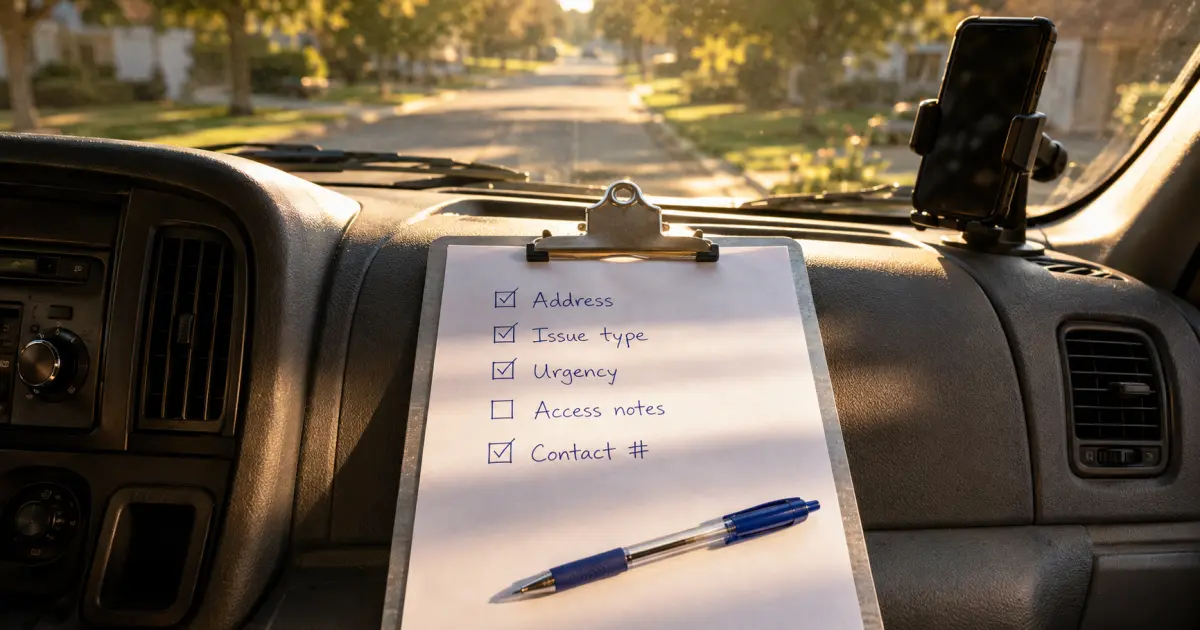
You’ve driven forty minutes to a job and the customer says “oh, it’s on the second floor.” You didn’t bring the right ladder. Or you show up to a clogged drain and the customer actually meant a sewage backup in the crawl space. Different job, different equipment, different price.
Every wasted trip starts with a bad intake call. And every bad intake call happens because the person answering the phone didn’t ask the right questions.
The intake that actually works
The best plumbing intake isn’t a checklist. It’s a conversation. One question at a time, in the right order, so the caller never feels interrogated.
Here’s the flow that captures everything you need without making the caller feel like they’re filling out a form:
1. What’s going on?
Open-ended. Let them describe the problem in their own words. Don’t jump in with categories or options. Listen, then ask the follow-up.
“Got it, tell me a little about what’s happening.”
2. Is it urgent?
Based on what they described, figure out the priority. Active water? That’s urgent. Dripping faucet? That can wait. You need to know this before you go any further because it changes the rest of the conversation.
If it’s urgent, speed up. Get the address and phone number fast. Everything else can come later.
3. Where is it?
The specific location in the house matters. Kitchen sink versus bathroom sink. First floor versus basement. Indoor versus outdoor. This tells you what tools and parts to bring.
“Is this in the kitchen, bathroom, or somewhere else?“
4. When did it start?
This helps you gauge severity. A faucet that’s been dripping for a week is different from one that started this morning. A water heater that quit today might just need a pilot light. One that’s been struggling for months might need replacing.
5. Service address
Get the full address. Apartment or unit number if applicable. Gate code if it’s a gated community. Whether they have dogs. Whether you can access the crawl space or the water heater location.
Confirm it. Read it back. A wrong address wastes a trip.
6. Contact info
Name. Best phone number to reach them. Whether they prefer a text confirmation or a call.
Don’t ask for email unless you’re sending a quote or a confirmation that requires it. Most plumbing customers would rather get a text.
7. Scheduling preference
Morning or afternoon? Which days work? If the caller has a hard constraint like “I’m only home before noon,” you need to know that before you book.
Offer simple choices. Don’t ask “when works for you?” because that creates decision fatigue. “Would Tuesday or Wednesday work better?” gets you to a booked job faster.
What not to ask
Just as important as what you ask is what you skip:
- Don’t ask for their life story. One question at a time. Get the answer. Move on.
- Don’t ask for information you won’t use. If you don’t need their email, don’t ask for it.
- Don’t quote a price on the phone. Unless you have a clear flat-rate for that service, just say “pricing depends on the job, but I can get you on the schedule.”
- Don’t stack questions. “Can I get your name, address, and phone number?” is three questions. Ask them one at a time.
Why this matters for your bottom line
A good intake call does two things. First, it makes the customer feel taken care of. They called with a problem and someone competent is handling it. That’s how you get five-star reviews.
Second, it makes sure you show up prepared. Right tools, right parts, right expectations. No wasted trips, no surprise scope changes, no “I’ll have to come back with the right equipment.”
Every plumber knows how expensive a wasted trip is. The drive time, the fuel, the lost slot that could have gone to a paying job. A clean intake eliminates most of those.
The gap in most answering services
This is where generic answering services break down completely. They don’t know what questions to ask for plumbing. They either ask too many generic questions or too few relevant ones. They don’t know that a burst pipe needs a faster response than a slow drain. They don’t know to ask about access notes or property type.
A plumbing-specific answering system follows this exact intake flow. One question at a time, in the right order, capturing the details that actually matter for the job. When it works right, you get a text summary that looks like a dispatch ticket: issue, address, access notes, urgency, customer name and number.
That’s what a good intake looks like. Not a script. A conversation.